

~ ST. ALPHEGE CHURCH ~
PALACE STREET, CANTERBURY
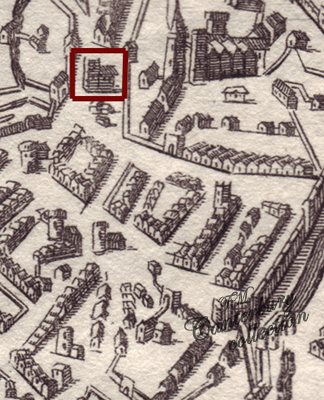
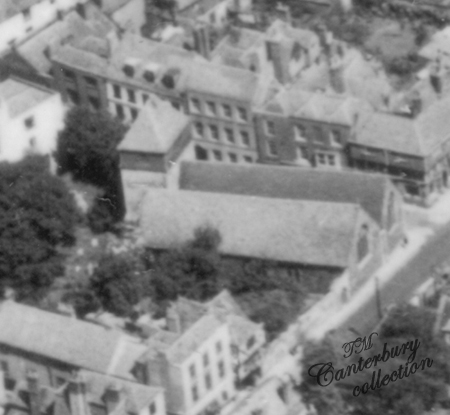
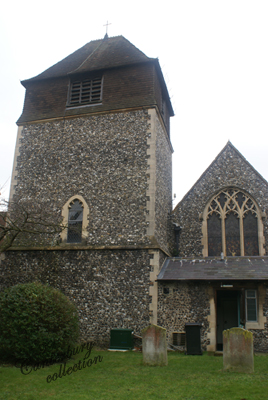
The church closed in 1982 and became the Canterbury Urban Studies Center, which then became The Canterbury Environment Centre, which is now closed. The church was taken over by the King's School, so no longer open to the public.
Parish records 1558 - 1981 available at the Canterbury Cathedral Archives CCA-U3-8
As time progressed, the foreign colony amalgamated with the native inhabitants, and resorted to many of the parish churches, especially St. Peter's, Holy Cross, and St. Alphage, whose registers, replete with the names of "strangers," have been published and ably edited by Mr. J. M. Cowper, of Canterbury.
The Regyster Booke of Chrystenynges, Maryages and Buryalls of the parish of St. Alphaege in the cyttye of Canterbury 1558 - 1800, 1889 J. M. Cowper
July 18th 1816 Burial of Mary TERRY of King Street age 58, Thomas Bennett, Rector
February 4th 1816 Burial of William GOULDEN of Borough of Staplegate age 3 months, Thomas Bennett, Rector
April 20th 1821, Burial of Henry GOULDEN, of Borough of Staplegate age 2 years and 6 months, Thomas Bennett, Rector
November 24th, 1824, Burial of Phobe GOULDEN, of Borough of Staplegate, age 76, J. P. Marriott, officiating Minister
June 15th, 1823, Burial of Henry GOULDEN, of Borough of Staplegate, age 8 months
"The Rev. George Hearne, in 1805, bequeathed £37 per annum, long annuities, for the support of a Sunday School for the parishes of St. Alphege and St. Mary Northgate, which sold in 1812 for £637. 5., and appropriated to the purchase and adaptation of a building for a National School, in which fifty-six children of those parishes are instructed." From the 1831 Topographical Dictionary
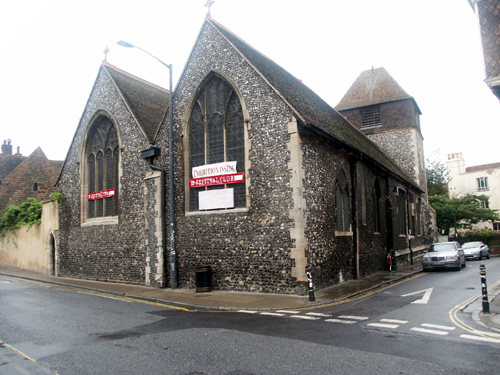
St. Alphage Church
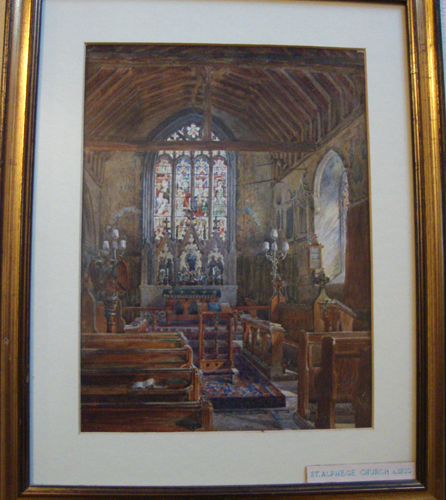
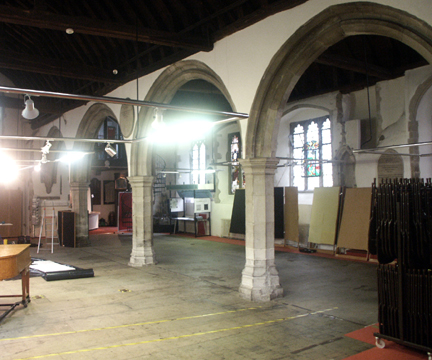
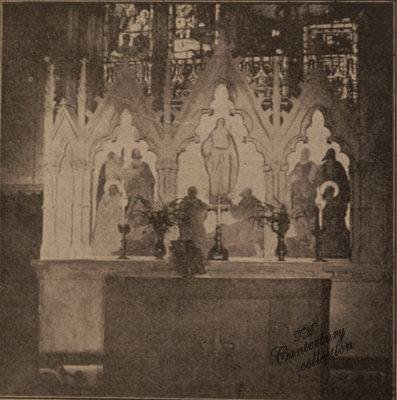
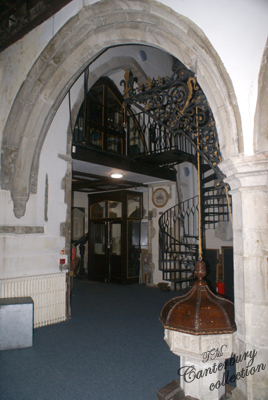
A view of the inside of St. Alphage church c. 1920 which is in St. Peter's church
"....From Yalden Mr. Taylor removed to Canterbury, and became a preacher of Christ-church in that city, where I presume he died, leaving behind him the character of an able critic in the oriental languages, and one of the most considerable divines of the assembly. He published several valuable works, and among others a translation of the Jerusalem Targum on the Pentateuch out of the Chaldee into Latin, dedicated to the learned Mr. Gataker, of Rotherhithe, with a prefatory epistle of Selden's, and several others, relating to Jewish antiquities. Among the letters to archbishop Usher there is one from Mr. Taylor, dated from Clapham, 1635. He corresponded also with Boetius, and most of the learned men of his time. He left behind him a son who was blind,* but ejected for nonconformity in the year 1662, from St. Alphage-church in Canterbury, where he lies buried.
*He lost his sight by the small pox; but pursued his studies by the aid of others, who read to him. His brother, who was also blind, he supported and took great pains to instruct and win over to serious religion, but not with all the success he desired; he was a man of good abilities, and noted for an eloquent preacher; and his ministry was much valued and respected. He did not long survive the treatment he met with, in being seized and carried to prison; but was cheerful in all his afflictions. Plamer's Nonconformist's Memorial, vol .2 pg. 57-58
The History of the Puritans, or Protestant Nonconformist 1822
Marriage, March 23, 1795 - At St. Alphage's, Canterbury, Mr. John STUBBS, silversmith of London to Miss Sarah NOLLOTH; and Mr. John COLLARD of Wincheap to Miss Susannah NOLLOTH; both daughters of Mr. John NOLLOTH, late of that city. Kentish Register 1795
"Robert Goseborne, Clerk, 3 July, 1523. My body to be buried in the Chancel of the Virgin Mary, before the high altar in the church of St. Alphage, Canterbury. To the altars of the blessed Virgins Katherine and Margaret, in Penshurst church; my parishioners of Penshurst; Alice Hardres, widow; to Master Roger Downvylle, Vicar of St. Pauls, Rector of St. Mary Magdalen; Master William Page, Vicar of Northgate; the Vicar of St. Dunstan's; the Rector of All Saints; the Rector of Bredman; Sir William Bull, and Sir William Hart. I will that ivl. xs. be expended for a marble stone for my tomb. Proved 5 October, 1523, at Canterbury" Testamenta Vetusta MDCCCXXVI
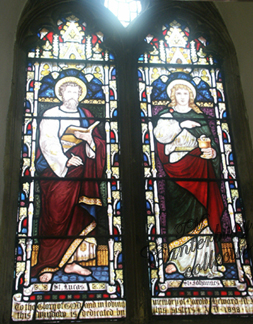
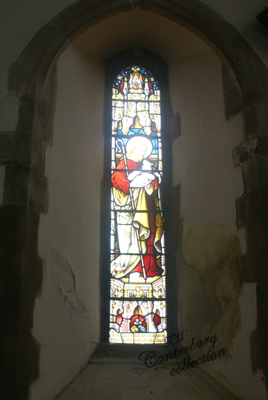
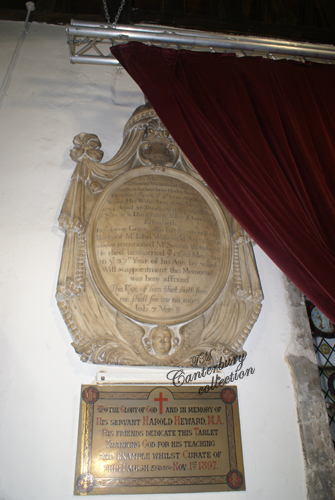
WT&HBH - Saturday, July 2, 1898 - The late Rev. H. Heward - Two memorials have recently been placed in St. Alphege church, Canterbury, in memory of the Rev. H. Heward, formerly curate of the parish. A two-light window in the north aisle has been fitted with stained glass, designed and executed by Mr. Caldwell, of Palace Street, and representing S.S. John and Luke, with the following inscription: "To the glory of God, and in loving memory of Harold Heward, M.A., this window is dedicated by his sisters." The other memorial consists of a brass tablet, inscribed "To the glory of God, and in memory of His servant, Harold Heward, M.A., his friends dedicate this tablet, thanking God for his teaching and example, whilst curate of this parish; November, 1897."
1838
Patron, The Archbishop of Canterbury
Incumbent & Rector - Wm. Edward HOSKINS, St. George's Place
Churchwardens:
James RIDOUT, Palace Street
J. J. WILLIAMSON, Sun Street
Parish Clerk, S. S. LUCAS, King Street
Sexton, James VILE, King Street
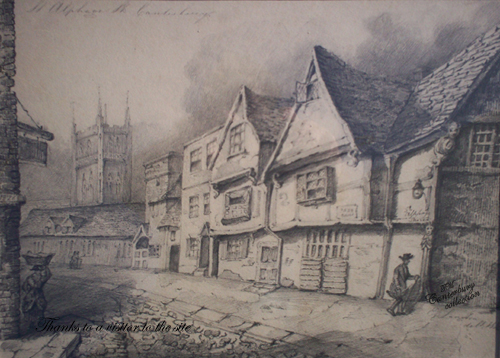
A drawing forwarded by a wonderful visitor to the site. Thank you!!
St. Alphage Lane c. 1826, Showing St. Alphage church and Bell Harry in the background.
Drawn by E. J. Langton. If you have any information on this artist, please contact me
"Henry Goseborne(1), of St. Alphe, Canterbury, Gent. and Alderman, of Burgate Ward, 11th April, 13 Henry VIII. 1522. My body to be buried in the Chapel of our Lady before her image, in St. Alphe's Church. The Lord Prior of Christchurch; Lord Abbots of St. Austin's and St. Gregorie's; my wives, Katherine and Agnes; Edward, my son; Margaret and Anne my daughters; Elizabeth my daughter, wife of Edward Gay; Agnes, my daughter, wife of Robert Hardinge; Alyce Symon, my daughter; Master Robert Goseborne, my brother; my lands in the City of Canterbury, and in the parishes of Wingham, Snave, Ivechurch, Brenzet, Chartham, Pelham, Hackyngton, Waltham, Goodnestone, and Monkton, in Thanet; Dame Ursula my daughter, a nun in Shepey, in the place of St. Sexburgh. I will that my son, Edward, when he come to the age of 22, shall have all my lands aforenamed, to him and his heirs for ever; and if he die before that age, I will that my lands in Canterbury, and in Hackyngton, Wyngham, and Goodneston, be sold, and that out of the money may be paid to the Mayor and Commonality of Canterbury XX marks, toward the reparation of the City wall, at such place or places as the Abbot of St. Austin's, and the Mayor for the time being, may assign; I will that the said Mayor and Commonalty shall not receive this gift, unless they put in sufficient security to bestow it according to my will and mind, immediately after receiving the same. If my said son marry after he is twenty years of age, and die before he is twenty-two, then I will that the said lands and tenements remain to such issue as he may have; but if he die before twenty-two, leaving no issue, then I will tha the said lands and tenements be equally divided among my then surviving daughters. Proved at Canterbury." Testamenta Vetusta MDCCCXXVI 1. Apparently brother of Robert Goseborne, Clerk, whose will is inserted above
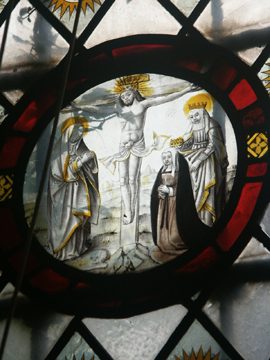
Nave South Window, 1st from east
"Edmund Talbot, of the parish of St. Elphe, in Canterbury, 28 October 1506. My body to be buried in the sanctuary of Christ Church in Canterbury. My brother Parson of St. Martyn's; Maister John Williams, Parson of St. George's. Proved at Canterbury" Testamenta Vetusta MDCCCXXVI
"St. Alphage Church is a spacious and respectable building, neatly fitted up, and containing many sepulchral memorials; among which are several for the family of Roberts, of whom Sir John Roberts, Knt. died in October, 1658, in his seventy-first year."
Topographical, Historical, Descriptive, and Literary, Delineation's in Kent, E.W. Brayley, October, 1807
"St. Alphage Church is a spacious and respectable building, neatly fitted up, and containing many sepulchral memorials; among which are several for the family of Roberts, of whom Sir John Roberts, Knt. died in October, 1658, in his seventy-first year."
The Beauties of England and Wales, 1808
William FEDARB son of James and Maria baptized May 1st, 1831 - St. Alphege, Canterbury
"Marriage, At Minster, Thanet, Rev. G. W. Sicklemore, Rector of St. Alphage, Canterbury, to Catherine, only child of Benjamin Bushell, esq. of Cieve, Kent." The Gentlemen's Magazine 1833
"Marriage, Sept. 19, at St. Alphage, Canterbury, John Paul Quick, of Grove-road, Brixton, eldest son of the late John Paul Quick*, Church-fields, Exeter, to Eliza, eldest daughter of Benjamin Mutton, Palace Street, Canterbury." The Gentlemen's Magazine 1860 *Benjamin Mutton was a Leather Seller, and was in Canterbury until 1861 when his family is in Summerhill, Harbledown *(c. 1852 St. Thomas, Devon)
 __
__
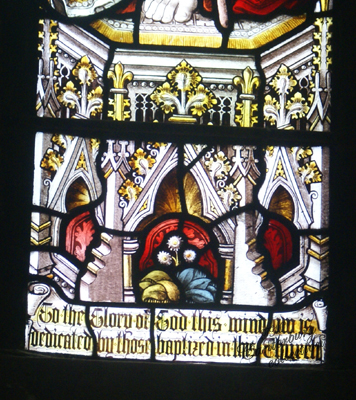
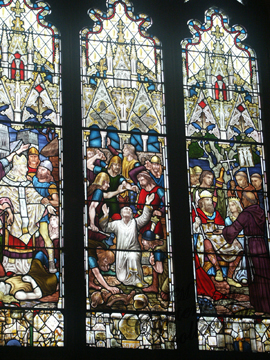
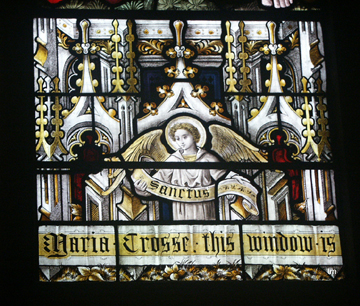
To the Glory of God this window is dedicated by those baptized in this Church
"Saint Elphege, perhaps erected on the site of a now lost church, dedicated to the "Four Coronati." There is in the church a quaint inscription on one of the pillars "Laude Prude Thoma, per quem fit ista columptna." It had two rhyming epitaphs on John Piers and Richard Engeham, respectively, and a memorial to Henry Gosborne, four times Mayor of Canterbury in the 16th century. There was an epitaph to Agnes Hawke. The allusion thereon, quoted as beginning "The dance in the churchyard," evidently bears a reference to the engravings of the "Dance of Death," at one time highly popular. This tablet is now gone; it stood once against the north side of the church. St. Elphege Church, from need of timely repairs, is fast hastening to its fall, tower and all. Every part of the building seems equally dilapidated. It contains the monuments of several eminent citizens and people of Kent.
Isabell Fowle gave lands for a priest to celebrate mass, and for the purchase of a lamp to burn for ever before the high altar. John Sellom made a somewhat similar bequest. The above-mentioned Thomas Prude bequeathed by his will, dated 1468, 5 marks to Christ Church, where he wished to be buried, and money to erect a pillar in St. Elphege Church, which indicates in some degree the date of the present building.
There is a memorial in the west aisle, with an iron helmet above it, to one of the Hadde family. John Caxton, the brother of the celebrated printer, lies buried in the church. He died October 12th, 1483. His will was proved at Canterbury the year following. He mentions no relations but his wife Isabella and his daughter Celia, but bequeaths sundry chattels, such as tablecloths and silver cups to friends. He was a mercer of the parish of St. Elphege."
Canterbury in the Olden Time by John Brent FSA 1879
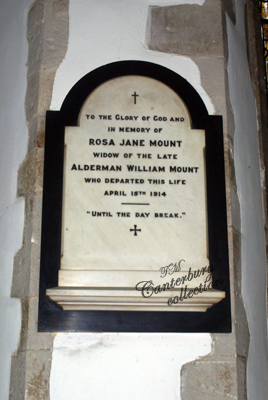
Rosa Jane Mount, widow of the late Alderman William Mount
"... In the same year, Robert Goseborne, Clerk, left ivl. xs. to be expended for a marble stone, which still remains at. St. Alphage, Canterbury, and is inlaid with brass.*"
A manual of monumental brasses *Test. Vetusta, p. 596. The brass figure measures 2ft. 3in., and has an inscription in six lines, and four shields. At St. Alphage, Canterbury, on the brass of Robt. Gosebourne, 1523, "et prece posce ei quod cupis esse tibi."
I. Robt. Gosebourne, "artibus instructor," and rector of Penhurst, 1523, in acad., 6 Lat. vv., pp. 60, 96.
Robert Goseborne, Clerk, 3 July, 1523. My body to be buried in the church of St. Alphage, Canterbury. To the altars of the blessed Virgins Katherine and Margaret, in Pensburst church; my parishioners of Penshurst; Alice Hardres, widow; to Master Roger Downvylle, Vicar of St. Pauls, Rector of St. Mary Magdalen; Master William Page, Vicar of Northgate; the Vicar of St. Dunstan's; the Rector of All Saints; the Rector of Bredman; Sir William Bull, and Sir William Hart. I will that ivl. xs. be expended for a marble stone for my tomb. Proved 5 October, 1523, at Canterbury.
II. A Sh. and inscr. to Thos. Prude, "per quem fit ista columpna," mur. Gent. Mag., vol. xix. N.S., 1843, pt. i. p. 483
A TIMELINE
Stephen Nicholson has been elected parish register in the parish of St. Alphage, Canterbury, and this court has been informed that Staplegate is a privileged area within the said parish but the inhabitants from time immemorial have used St. Alphage church for marriages, burials and christenings, therefore Staplegate shall be united with St. Alphage for registration purposes. - East Kent Order Book, Midsummer 1654
In 1782 there was a consecration of additional burial grounds for St. Alphege.
October 7th, 1816, the marriage of John TERRY, bachelor of this parish, and Hannah Steady, spinster of this parish, were married in this church by Banns with consent of _____ this seventh day of October in the Year One thousand eight hundred and sixteen by me Tho. Bennett, Rector. This marriage was solemnized between us John Terry Hannah Steady in the presence of James Terry and Sarah Bicker? X her mark *James Terry, Polls 1830 - Dane John - Gardener
The Rectory House was taken down in 1875 and the materials sold off.
The church was reseated and the gallery removed in 1885.
The church was renovated in 1888.
In 1895 there was an erection of a stone reredos.
In 1907 they erected a memorial window to Alderman Mount.
In 1915 they erected a memorial tablet to Mrs. William Mount.
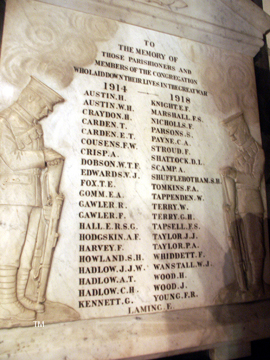
My photo of the War Memorial in the church (the memorial used to reside on the South Wall inside the church c. 1940's) it now sits in the entrance.
In 1920 they erected a war memorial.
In 1930 there was a rehanging of the bells in a new frame.
In 1937 there was an erection of a memorial tablet to Mrs. Alderman Wells.
In 1952 an erection of a reredos, altar and tablet; various works to the organ, reredos and altar. This was a gift of Henry John Upton.
In 1960 they installed a gas fired boiler and rearranged the seating.
In 1966 they loaned the silver chalice, paten and alms dish to Warwick University.
In 1967 they made repairs to the interior and exterior and rewired the electrical system.
In 1975 they gave the ancient helmet on permanent loan to the Beaney Institution.
In 1981 they made repairs to the belfry roof and tower.
In 1982 the high altar of the redundant church was given to St. Michael's, Hernehill, some of the other items went to SS Peter and Paul, Upper Hardres.
A rollover map of the church (You must have Flash player installed to use this)
""Passing the entrance gateway to the cathedral, and going through Sun Street into Palace Street, the interesting church of St. Alphege will be noticed at the angle of the latter street with a street called after the church. There is a trace of Norman twelfth-century work on the face of the westernmost pier of the north arcade. The church was recast in the thirteenth century, when the tower was built, and the chancel extended eastward, deflecting to follow the line of the street; to this period belong the tower arch, and the priests' doorway, and several lancets of the chancel. The west window of the nave is a fine example of the fourteenth century. The church assumed its present form in the fifteenth century. The works were in progress in 1468, when Tomas Prude left by his will 'as much as will build a pillar in the church.' This pillar is the second from the west end, and a thoroughly good specimen of work in Kentish rag masonry; it bears, on the western face, a small niche and the coat-of-arms on a brass shield of the donor, with the words, Gaude Prude Thoma per quem fit ista columna.
163,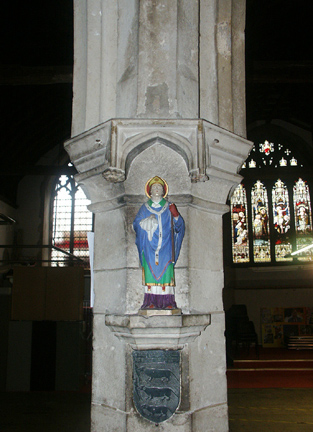 164
164
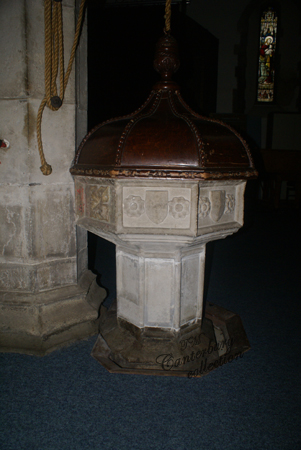
The other windows of the church are of this date and excellent of their kind. The well-designed font is also fifteenth century; it has a good cover with handsome iron crane or cantilever of somewhat later date. The rood-loft must have been a great feature of this church; it went right across the nave and Lady Chapel and had a stair turret at each end. The northern stairs remain; they were gained through a richly treated doorway. Somner gives a most interesting English rhymed inscription, which was extant in his day, recording the gifts of John Caxton and his wife, in 1485, to the church. (this is it below)
"Pray for the sawlys of John Caston and of Jone,
And Isabel that to this church great and good hath done,
In making new in the chancel
Of deskys and seats as well,
An antiphon the which did bye.
With the table of the martyrdom of St. Alphye,
For nothing much which did pay,
And departed out of this life of October, the 12th day;
And Isabell, his second wiff,
Passed to bliss, where is no strife,
The xiith day to tell the trowth,
Of the same moneth as the Lord knoweth,
In the yeare of our Lord God, a thousand, fower hundred, fowerscore and five."
They gave new seats and desks for the church, with an antiphonar and a painting of the martyrdom of the patron saint, and many other benefactions, among which may have been the rood-loft. A small fragment of the Caxton work in carved oak, giving a rebus of their name, is embodied in the new fittings of the chancel. In the chancel brass, with small effigy, to the memory of Robert Gosebourne, rector of Penshurst, who died in 1523. Henry Gosebourne, his brother, who died in 1522, was four times mayor of Canterbury and was the father of twenty-five children. St. Alphege's is the best restored of the churches of Canterbury, where there has been so much done of a wholesale character; the work was done by Mr. R. H. Carpenter in 1888."
J.Charles Cox, Canterbury A history of the Ancient City, 1905
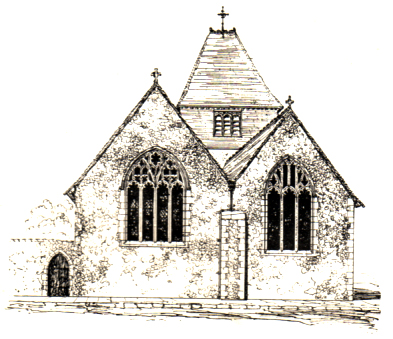
Drawing from my book "History of the church of St. Alphege Canterbury" 1888
St. Alphage church is situated in the north part of the city, on the west side of Palace Street, it is a large handsome building, consisting of two isles and two chancels, having a square tower steeple at the west end of the north isle, in which are three bells.* Thomas Prowde, of this parish, died anno 1468, and by his will gave one pair of organs, to the use of this church. By the return of the king's commissioners, anno 2 Edward VI. it appears, that there were lands given by Isabell Fowle, by her will, for a priest to celebrate masse within this church; also for one torch yearly to serve the high alter for ever. That there was lamp-rent likewise given by John Sellowe, for one lamp to burn yearly before the image of St. John the Evangelist within this church forever.
This church, which is a rectory, is exempted from the jurisdiction of the archdeacon. It has been from early times part of the possessions of the see of Canterbury, and still remains so, being at this time, with the vicarage or church of St. Mary Northgate, united to it in 1681** of the patronage of his grace the archbishop. The church of St. Alphage is valued in the king's books at 81 13s. 4d. and the yearly tenths at 17s. 4d. the church of Northgate having been united to it since, being valued separate from it. In 1588 it was valued at 30.. Communicants 120. In 1640 it was valued at 40l. Communicants the like number. The parsonage-house, which adjoins to the church and church-yard southward, has had two good benefactors, in Mr. Herbert Taylor, formerly rector of this church, and Mr. Hearn, the present rector. There are two terriers of this rectory, the one dated anno 1637, the other April 27, 1747, in the registry of the consistory court of Canterbury.
There are many burial stones in the church that can no longer be seen, as they are hidden underneath the carpet
Anthonetta CRAYFORD & Peter CRAYFORD Gentleman
Revd. Mr. LE SUEUR & Mary Margaret LE SUEUR, erected by their niece Frances LE SUEUR
Magdalen PELISSIER (born in Montepelllier in France)
Thomas HAMMOND Solictor
Elizabeth HAMMOND (daughter of Thomas and Mary Hammond)
Murray MacGREGOR Esq (46th Regt)
Elizabeth KNOTT (wife of John KNOTT)
John KNOTT (brewer) Mary FOWTRELL (wife of Michael FOWTRELL and daughter of John KNOTT)
James KNOTT (son of James Knott)
Wiliam KNOTT, James KNOTT (his son) and Anne FOWTRELL (youngest daughter of Michael and Mary FOWTRELL)
William BROWNING and Alice BROWNING his wife
Elizabeth KIRBY (daughter of John and Jane KIRBY)
Thomas WISE (latin transcription)
English translation for Thomas WISE courtesy of Pat Smith
"Near this marble
Thomas Wise Professor of Sacred theology
From gentry stock originating in the County of Oxford
Pastor of this parish and of Beaksbourn
Ecclesiastical [postions] Canterbury: One of the Six Preachers
Prebend of Lincoln [Diocese]
Chaplain to the Princess of Wales
A learned and orthodox theologian
Who died 24 July in the year of salvation 1726
His age was 55"
Phebe LEFROY
Algerina DASHWOOD, eldest daughter of George DASHWOOD esq. and niece of Bridget KNOTT
Elizabeth MACKFARLIN (daughter of Peter and Elizabeth Mackfarlin)Thoma
*Somner mentions the following burial inscriptions on brass in old English letters, in this church, all long since destroyed; namely one in the chancel for John Piers, rector. For John Parmenter, rector, commissary of Canterbury likewise and rector of Adisham, ob. 1501. For Robert Provest, rector ob. 1487. For John Lovelych, B.L. Rector and likewise register of the archbishops consistory at Canterbury, ob 1438. For Richard Stuppeny, B.L.L. proctor, obt. 1596. In the south cancel, for Henry Gosborne, gent. of St. Alphege, alderman, and four times mayor of this city, in the chapel of our Lady, obt. 1522. He had two wives, by whom he had 25 children; he by his will gave 20 marcs, (a large legacy in those days) towards repairing the city walls. On his stone these two shields, Sable, a fess, gules, between three swans, argent; and Vert, a saltier, argent, a chief, ermine. Robert Gosborne, rector of Penshurst, his brother, obt. 1523. For Richard Engham, of Great Chart, obt. 1568. In the middle isle, for John Caxton, and Joane and Isabel his wives, he was a benefactor to this church, and died in 1485. On the second pillar from the west end, on a brass plate, the only one now remaining of those mentioned by Somner, Gaude Prude Thoma, per quem fit ista Coumpna, with his coat of arms. He lived in king Edward IVth's days, and by his will appointed to be buried by Christ-church porch, and gave by it as much as would build a pillar in this church, and five marcs to the works of Christ-church, anno 1468. In the west window, the figures of Edmund Staplegate and Elenor at Pytte, his wife, in coloured glass, and underneath, Orate p. aibus, Edmdi Staplegate, & Elenora at Pytte, uxoris ejus. This man, who took his name from his habitation at Staplegate, adjoining to this parish, was in king Edward III's days, several times one of the bailiffs of this city. There were formerly many coats of arms in the windows of the church, most of which have been long since destroyed. __________
 |
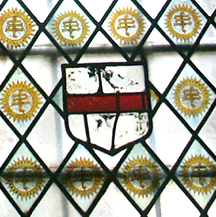 |
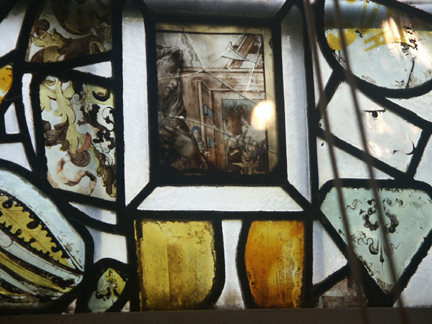
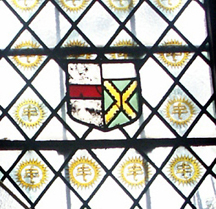
My photo's of the details of the stained glass "coats of arms" in the church
___The following monuments and gravestones are among others in this church at this time: A memorial near the altar-rails for Thomas Wife, S.T.P. descended of a genteel family in Oxfordshire, incumbent of this parish and of Beakesborne, a six preacher of this cathedral, and a prebendary of that of Lincoln; he died in 1726; arms, Three chevronels. Another next to the last, for Brodnax Brandon, gent. eldest son of William Brandon, late of Portsmouth, by Anne his wife, daughter of Sir William Broadmax, of Godmersham, obt 1733; arms, Barry of ten, over all a lion rampant, ducally crowned; impaling a cross fleure. An inscription on a brass plate for John Mainwaring, esq. of an ancient and noble family of that name, of Pyvor, in Cheshire, ob. 1621. An inscription on the same stone, inscribed the reverse way, for Elizabeth, daughter of William Maundy, M.D. formerly of this city, obt. 1776. In the north isle are memorials for several of the Knowlers. A mural tablet for Samuel Vassal, esq. son of a Colonel John Vassal, obt. 1714,: arms Azure, a sun in chief, a vase in base, or. A memorial for Peter Peters, of the dissolved Dominican monastery, near this parish, M.D. the eldest son of John Peters, M.D. of the same place, obt. 1697. Under the same stone lies buried Elizabeth his wife, obt. 1722; arms Peters, or, three roses, gules; on an escutcheon of pretense, Stoning, argent, on a chevron gules, three martlets, between three hurts, each charged with a fleur de lis, or. Another for Anne, eldest daughter of Peter Peters, M.D. ob 1712. One for Michael Peters, gent. obt. 1754. On a hatchment at the north-east corner, an inscription for John Stockar, rector almost 46 years, obt. 1708. On another at the south side of the north isle, arms, Bix, on a escutcheon of prentence, Gules, a chevron, or; and an inscription for Mr. Thomas Bix, of Bishopsgate, London, buried here near his grandfather and grandmother, obt. 1697.
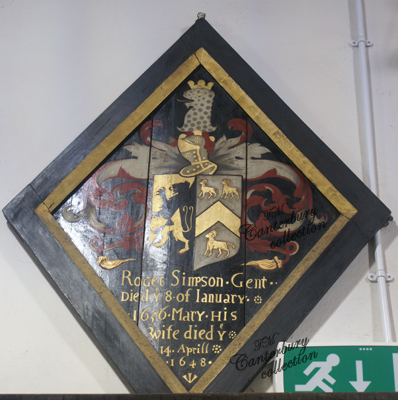
On another against the north wall, arms, Simpson, impaling vert, a chevron, between three rams pasant, or. for Roger Simpson, gent. obt. 1656. Mary his wife, obt. 1648. A memorial for William Crayford, esq., formerly recorder, obt. 1733. For Susanna, widow of William Crayford, esq. obt 1775. Several other memorials for the family of Crayford, both on gravestones and hatchments.
|
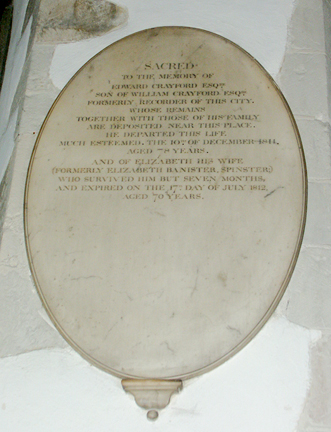
My photo of a memorial in the church |
Sacred to the memory of Edward Crayford Esq. Son of William Crayford Esq. Formerly Recorder of this city whose remains together with those of his family are deposited near this place. He departed this life much esteemed the 10th of December 1811, aged 78 years. And of Elizabeth his wife (formerly Elizabeth Banister, Spinster) who survived him but seven months, and expired on the 17th day of July 1812, aged 70 years. |
A memorial for George Hammond, gent. obt. 1761; also Mary his widow, obt. 1782; likewise Mary their daughter, obt. 1788; and for Thomas Hammond, gent. (attorney and several years chamberlain of this city) their son, obt. 1791. A memorial in the north aisle, for the Rev. Mr. Le Suer, minister to a French Episcopal chapel in this city, obt. 1746: also for Margaret his wife, obt. 1749. Several memorials for the Knotts and Foutrells. A memorial for Algerina Dashwood, eldest daughter of Geo. Dashwood esq. obt 1713; arms in a lozenge, On a fess, three griffins heads, erased.
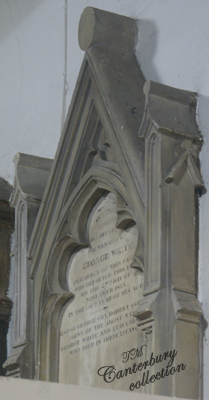 |
In ... Beneath are deposited the remains of GEORGE WHITE formerly of this parish who departed this life on the 27th day of November 1851 In the 56th year of his age Also of George-Fry, Robert y ... Sons of the above named George White and Elizabeth who died in their infancy
|
In the fourth isle, a small mural monument for Matthew Hadde, eldest son of Henry Hadde, of Frinsted, both alike esqrs. He was of the society of Lincoln's-Inn, and for twenty seven years performed the office of justice of the peace within this city. He was steward of four courts, ... of the chancery of the cinque ports at Dover; 2d, of the royal manor of Wye; 3d, of the dissolved monastery of St. Augustine; and lastly of the town and port of Faversham; and practised as a barrister at law to the count at large, obt. 1617; arms at top, Gules, three stags heads caboshed, or, between the horns of each a cross croslet, fitchee, argent, a crescent for difference.
|
WT&HBH - Saturday, July 2, 1898 - The late Rev. H. Heward - Two memorials have recently been placed in St. Alphege church, Canterbury, in memory of the Rev. H. Heward, formerly curate of the parish. A two-light window in the north aisle has been fitted with stained glass, designed and executed by Mr. Caldwell, of Palace Street, and representing S.S. John and Luke, with the following inscription: "To the glory of God, and in loving memory of Harold Heward, M.A., this window is dedicated by his sisters." The other memorial consists of a brass tablet, inscribed "To the glory of God, and in memory of His servant, Harold Heward, M.A., his friends dedicate this tablet, thanking God for his teaching and example, whilst curate of this parish; November, 1897." |
In Memory of Mr. Simon Wakefeild of this Parish who was here Under buried He died April ye 4th 1710 Aged Years. His Wife Ann died May ye 22 1714 Aged 58 Years. And they left issue 1 Son & 2 Daughters John Eleanor & Elizabeth In ye same Grave also lieth interr'd the Body of Mr. John Wakefeild Son of the above mentioned Mr. Simon Wakefeild He died unmarried ye 13th of May 1719 in ye 37th Year of his Age by whole Will & appointment this Memorial was here affixed The Eye of him that hath seen me, shall see me no more Job 7 Ver: 8 |
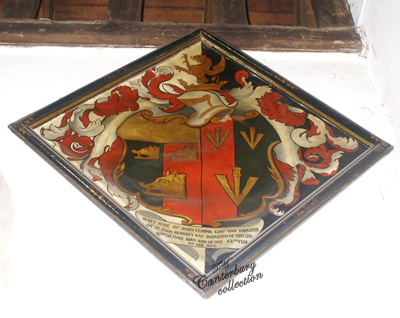
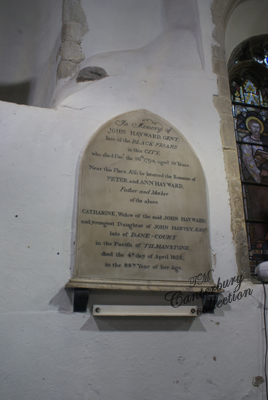
Several memorials on monuments, hatchments, and gravestones, for the family of Roberts; arms, Per pale, gules and azure, three pheons heads, argent. On hatchment opposite the south door, for Mary, wife of John Coppin, gent. and daughter of Sir John Roberts, obt. 1585. A memorial for Mrs. Deborah Timewell, only daughter of John Bridges, esq. late of this city, and wife of Edward Timewell, esq. of Chigwell, in Essex, obt. 1752; also for the said Edward Timewell, esq. obt. 1762. He was the eldest son of Benjamin Timewell, esq. one of the commissioners of the navy in the reign of Queen Ann; arms, Or, on a chief, crenelle, three lions heads, erased, impaling, on a cross, a leopard's face. A mural tablet on the north side for John Hayward, gent. obt. Dec. 26, 1794;
 ______
My photo's of memorials in the church
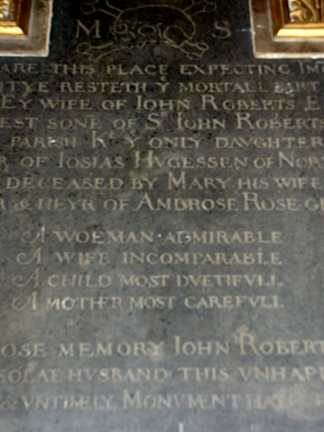
"The marble tablet on the right reads "Near this place, expecting immortalitye, resteth the mortal part of Jane the wife of John Roberts, Esq. eldest son of Sir John Roberts of this parish, knight, the only daughter and heyr of Josias Hugesson, of Norton, Esq. by Mary his wife, daughter and heyr of Ambrose Rose, gent. A woman admirable, A wife incomparable, A child, most dutiful, A mother, most careful. To whose memory John Roberts, her inconsoleable husband, this unhappy, unequal, and untimely monument has placed. She left issue only Jane her daughter."
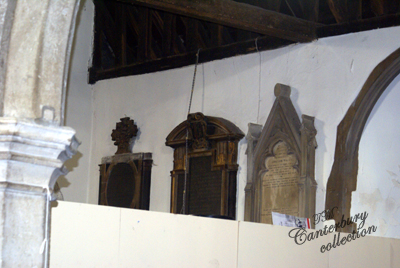
The memorial in the centre used to have a helmet above it in the pre-WW2 years
another mural tablet on the south side for William Bennet, obt. June 26, 1782, and for Sarah his mother, obt. 1780. There are some good remains of painted glass yet left; among which are the following coats of arms, Sable, a fess, gules, between three swans argent; the same impaling Vert, a saltier, or, a chief ermine; a chevron, between three birds heads, erased, and Gules, a saltier, or. Among the wills in the Perog. off. Cant. I find that William Prowde, of St. Elphe, was buried in 1596 in this church, before the altar of St. James and St. Erasmus. He gave by his will 3l. towards the making of a new pair of organs, to be set up on the north side of the choir, before the image of St. Elphe; also 40s. to a clerk to be provided to play on the same at high feasts. Serlys Prude, alias Proude, gent. of St. Alphage, in 1584. Christopher Turner, gent. of this parish, in 1591. Thomas Maneringe, gent. in 1593. Christopher Nevinson, gent. of this parish in 1617. In the chancel, Henry Hales, gent. of the precincts of Christ-church, in 1679, near his grandchild Mary, daughter of his son John Hales; Mary Hales, of the precincts of the Archbishop's palace, widow, in 1687. Anne Herault, spinster, of Canterbury, near her mother and sisters in 1720. Besides the above burials in this church, there is frequent mention in the parish register of it, which begins in 1558, of the Lovelaces, Masters, Juxons, Hadde, Denews, Dennes, Foches, Primroses, etc.
fol. 16r. Court given to understand that William Holybone `halywaterclerk' on 24 Oct, 16 Edward IV assaulted etc in parish of St Alphage one William Proude. In following entry recounts that William Proude assaulted W.Holybone bacul' et glevys. Proude claims that W.H. assaulted him with a stone, etc (1476-77, Court of Pleas) cca-cc-J/B/1/276
**See the account of petitions having been presented for the uniting of these churches, and the archbishop's decree thereon, before, p. 211; by which this church of St. Alphage and St. Mary Northgate were united, both belonging to the same patron; and that the former should for ever be the church representative, and that the parishioners of each should resort to the same, as to their proper church.
Hasted's Historical and Topographical Survey of Kent (second edition)
|
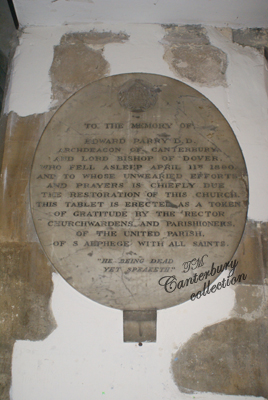
Edward Parry Memorial |
To the Memory of EDWARD PARRY D.D. Archdeacon of Canterbury and Lord Bishop of Dover Who fell asleep April 11th 1890 And to whose unwearied efforts and prayers is chiefly due the restoration of this church this tablet is erected as a token of gratitude by the rector churchwardens and parishioners, of the United Parish, of S Alphege with All Saints. "He being Dead Yet speaketh" |
...and St. Alphege's within the walls, which were not of the partronage of some religious house or abbey, in or in the near neighbourhood of the city, and these two were in the patronage of the archbishop. Battely's Somner
This church, which is a rectory, is exempted from the jurisdiction of the archdeacon. It has been from early times part of the possessions of the see of Canterbury, and still remains so, being at this time, with the vicarage or church of St. Mary Northgate, united to it in 1681, of the partronage of his grace the archbishop. The partronage-house, which adjoins to the church and church-yard southward, has had two good benefactors, in Mr. Herbert Taylor, formerly rector of this church, and Mr. Hearn, the present rector.
__
TERRY christenings at St. Alphege
John Terry - January 22, 1654, to John Terry
John Terry - August 5, 1655 to Michaell Terry
Judick Terry - July 8, 1657 to Miell Tery
Jane Terry - March 19, 1657 to Winson Terry
Thomas Terry - April 12, 1668 to Thomas and Elizabeth Terry
Martha Terry - March 26, 1671 to Thomas and Elizabeth Terry
Anne Terry - June 30, 1673 to Thomas and Elizabeth Terry
Elizabeth Terry - December 2, 1675 to Thomas and Elizabeth Terry
Helene Terry - November 25, 1677 to Thomas and Elizabeth Terry
Elizabeth Terry - February 10, 1681 to Thomas and Elizabeth Terry
John Terry - September 5, 1697 to Nicholas and Mary Terry
John Terry - February 6, 1703, to John and Amy Terry
...St. Alphage, Canterbury, we read of Richard Harryse, who "died of worms," and in the year 1784 small-pox is mentioned.
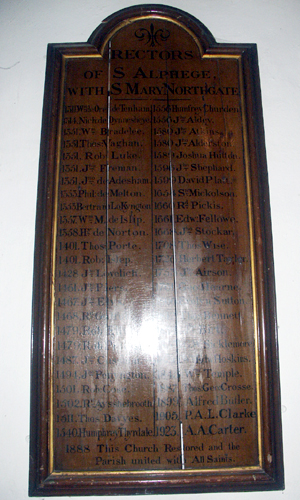
On a plaque made of wood? framed located on the wall on the right hand side as soon as you walk in the doors off of St. Alphege Lane
TERRIERS
Terriers, or surveys of church property.
anno 1637 - Canterbury St. Alphege - ref. DCb/D/T/C/3 - Terrier (Diocese of Canterbury)
April 27, 1747 - Canterbury St. Alphege - ref. DCb/D/T/C/4- Terrier
1837 - Canterbury St. Alphege - ref. DCb/D/T/C/5- Terrier
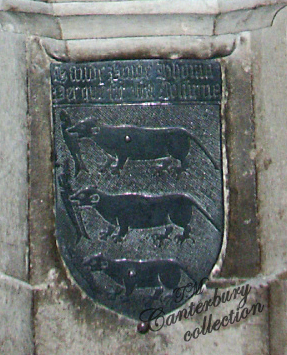
Gaude Prude Thoma
Per Quem fit ista columpna
My photo of the brass plaque with the coat of arms on the pillar *This is the only one of the Epitaphs now remaining which were there in Somner's time. "Prude lived in Edward IV's days, and by his will appoints to be buried by Christ Church Porch, and therein gives as much as will build a pillar in this church, and 5 marks to Christ-church works, Anno. 1468" Battleley's Somner, p.
Among the wills in the Prerog. off Cant. I find that William Prowde,
of St. Elphe, was buried in 1596 in this church, before the altar of
St. James and St. Erasmus. He gave by his will 3l. towards the making
of a new pair of organs, to be set up on the north side of the choir,
before the image of St. Elphe; also 40s. to a clerk to be provided to
play on the same at high feasts. Serlys Prude, alias Proude, gent. of
St. Alphage, in 1584. Christopher Turner, gent. of this parish, in 1591.
Thomas Maneringe, gent. in 1593. Christopher Nevinson, gent. of this
parish, in 1617. In the chancel, Henry Hales, gent. of the precincts
of Christ-church, in 1679, near his grandchild Mary, daughter of his
son John Hales; Mary Hales, of the precincts of the Archbishop's palace,
widow, in 1687. Anne Herault, spinster, of Canterbury, near her mother
and sisters, in 1720. Besides the above burials in this church, there
is frequent mention in the parish register of it, which begins in 1558,
of the Lovelaces, Masters, Juxons, Hadde, Denews, Dennes, Foches, Primroses,
&c.
___Article 1 from the Gentlemen's Magazine (pdf file)
Article 2 from the Gentlemen's Magazine (pdf file)
Article 3 from the Gentlemen's Magazine 1863 (pdf file)
All Saints church in High Street was once used as a Sunday school for St. Alphege's, to which it was united. c. 1905
Roman artifact - considerable piece of tessellated pavement was found opposite St. Alphege's Church.
Rectors of St. Alphage (pdf file)
As time progressed, the foreign colony amalgamated with the native inhabitants, and resorted to many of the parish churches, especially St. Peter's, Holy Cross, and St. Alphage, whose registers, replete with the names of "strangers," have been published and ably edited by Mr. J. M. Cowper, of Canterbury.
November 29, 1824 - death, lately in the Precincts, Canterbury aged 53, the Rev. Thomas Bennett, Minor Canon of the Cathedral; Vicar of St. Alphage, and Rector of St. Mary Northgate, Canterbury; and Vicar of Stone, Isle of Oxney. He was of Trinity College, Cambridge, A.B. 1792, A.M. 1795. He was elected Minor Canon in 1810, presented to St. Alphage in 1812 by Archbishop of Canterbury; and in 1820 to the Vicarage of Stone, by the Dean and Chapter.
Sequestration of rect of St. Alphage Canterbury with vic of St. Mary Northgate Canterbury to Reverend George Parry Marriott, James Ridout and John James Williamson churchwardens of St. Alphage and John Beard and Charles Brockwell, churchwardens of St. Mary Northgate, void by death of Thomas Bennett. (Vol 36 Kent, Surrey, London: Canterbury Marriage Licences, 1810-1837)
poss 1832 - 1836 - George Wilson Sicklemore (at (Vicarage house 1851) (Nethercourt house 1861 - 1871), Vicar of St. Lawrence, J.P. for Kent) *Trinity College Cambridge 1826 *previously cur for All Saints and St. Mildred Canterbury?
1851 - William Temple rector of St. Alphage & Vicar of St. Mary Northgate, Canterbury *living at 10 St. Alphage Lane
1860 Rev. W. Temple, Rector of St. Alphage, Canterbury, Eastbridge Hospital, Canterbury - Member of the Kent Archaeological Society
1882 - Rev. William Temple M.A. (surrogate), Hours of Service: 10:30 am. 7 pm.
1889 - 1903 - Rev. Alfred Butler M.A. (St. John's College Cambridge, and master of Eastbridge Hospital), Hours of Service: 11 am. & 3 & 6 pm.; alternate sun. 8:15 am; wed. 8:15 pm. winter only
1917 - Rector, Rev. P. Clarke (B.A.); Churchwardens, Messrs. T. Young and S. Horton, Sidesmen, MEssrs. Bunce, Price, Wills, Davidson and Nash.